How to Learn AI Skills in 2026: The Ultimate Beginner’s Guide

How to Learn AI Skills
Artificial intelligence is changing the way people study, work, create content, and run businesses. From writing articles and designing images to analysing information and automating everyday tasks, AI is becoming a useful part of modern life. The good news is that you do not need to be a programmer or a technology expert to get started.
If you are wondering how to learn AI skills in 2026, you are in the right place. You can begin with free learning resources, practise with beginner-friendly AI tools, and gradually build practical skills using your laptop and an internet connection.
Learning AI does not mean learning everything at once. It means understanding the basics, discovering how different tools work, and finding ways to use them to solve real problems. Whether you are a student, blogger, freelancer, job seeker, or business owner, developing AI skills can help you work more efficiently and explore new opportunities.
In this ultimate beginner’s guide, you will discover the essential AI skills to learn, useful free courses, practical tools, simple project ideas, and ways to use your knowledge to earn money online.
What Are AI Skills and Why Are They Important?
How to Learn AI Skills
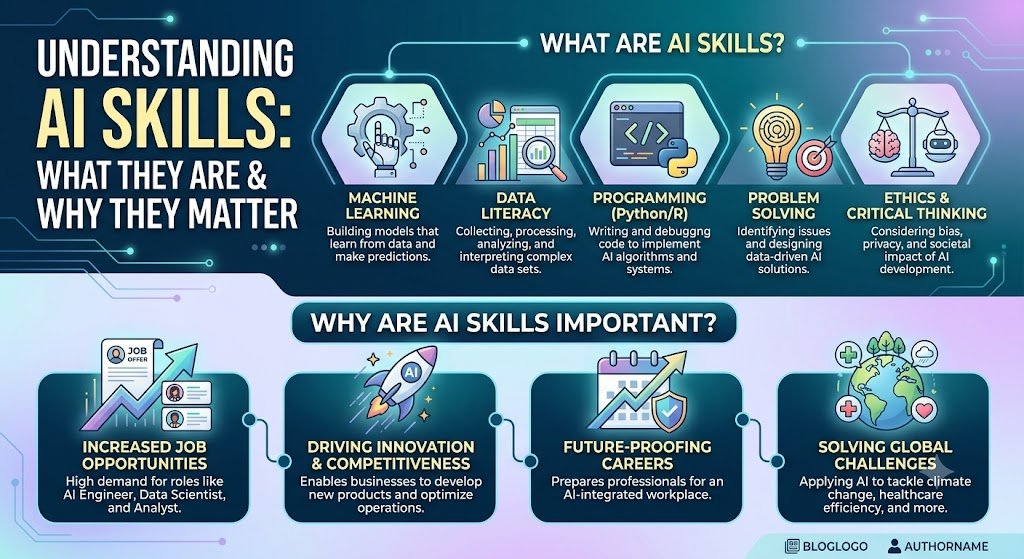
AI skills are the knowledge and abilities that help you understand, use, evaluate, or develop artificial intelligence technologies. These skills range from writing effective prompts for AI chatbots to building machine learning models and automating repetitive tasks.
For beginners, learning AI skills does not necessarily require advanced mathematics or programming. You can start by learning how AI tools work and practising them in your daily activities.
For example, a blogger can use AI to brainstorm article ideas, a student can use it to understand difficult concepts, and a small business owner can use AI tools to prepare marketing content. In each case, the person is learning to use AI to complete a task more effectively.
Why Are AI Skills Becoming Important?
1. Better productivity: AI tools can help you brainstorm ideas, summarise information, organise tasks, and prepare first drafts more quickly. You still need to check the results, but AI can reduce the time spent on routine work.
2. New career opportunities: Many industries are exploring AI for customer service, marketing, software development, research, data analysis, and business operations. Practical AI knowledge can complement your existing qualifications and professional experience.
3. Improved creativity: AI can help you explore different writing styles, develop design concepts, create content outlines, and experiment with new ideas.
4. Smarter decision-making: AI can help organise information and identify patterns. However, important decisions should still rely on accurate data, human judgement, and appropriate verification.
5. Opportunities for online work: People who combine AI knowledge with valuable services, such as content writing, social media management, research, and automation, may find opportunities to work with clients online.
The main reason to learn AI is not simply to follow a trend. It is to develop practical abilities that help you solve problems, create useful work, and adapt to changing technology.
Essential AI Skills Every Beginner Should Learn
How to Learn AI Skills
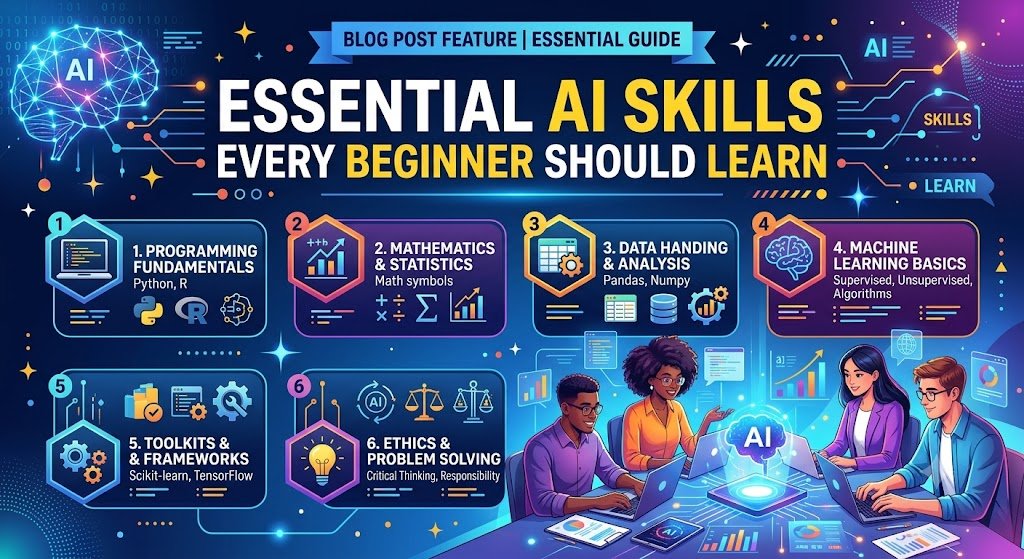
Before searching for advanced courses, focus on a few fundamental skills. These will give you a strong foundation and make it easier to learn more complicated topics later.
1. Prompt Engineering
Prompt engineering means giving an AI tool clear instructions so that it can produce a useful response. A good prompt explains what you want, provides relevant context, and describes the format of the answer.
For example, instead of writing, “Write about digital marketing,” you could ask:
“Write a beginner-friendly blog introduction about digital marketing in approximately 150 words. Use a conversational tone, include practical examples, and explain why digital marketing matters to small businesses.”
The second prompt gives the AI more information about your requirements.
Practise specifying the task, audience, tone, length, and desired format. Learn to improve your prompts when the first answer is not useful.
2. Understanding AI Tools
Learn how to use different categories of AI tools, including chatbots, writing assistants, image generators, research assistants, and productivity tools.
Do not try to master dozens of applications immediately. Start with one or two tools and understand their strengths, weaknesses, limitations, and pricing.
The goal is to choose the right tool for a task rather than use AI simply because it is available.
3. Basic Data Literacy
Data literacy means understanding information, recognising patterns, reading charts, and checking whether conclusions are supported by evidence.
You do not need to become a data scientist on your first day. Start by learning spreadsheets, basic calculations, charts, and simple data organisation.
These abilities will help you evaluate AI-generated answers and prepare for more advanced subjects such as data analysis and machine learning.
4. Critical Thinking and Fact-Checking
AI systems can produce incorrect facts, outdated information, misleading explanations, or invented references. Learning how to verify information is therefore essential.
Check important claims against trustworthy sources, examine calculations, and confirm that cited references actually support the information.
Remember that an answer that sounds confident is not necessarily correct. Human judgement remains an important part of working with AI.
5. Basic Coding and Automation
If you are interested in a technical AI career, consider learning Python, basic programming concepts, APIs, and automation.
Python is widely used in data science and machine learning. Start with variables, conditions, loops, functions, lists, and simple projects before exploring AI libraries.
Coding is not compulsory for every AI-related job. However, it can open additional opportunities if you want to develop software, work with data, or build AI-powered applications.
6. Communication and Problem-Solving
AI skills become more valuable when you can understand a problem and explain a solution clearly.
Learn to break large tasks into smaller steps, communicate with clients, organise your work, and present results in an understandable way.
Combining AI knowledge with writing, design, marketing, business, or another existing skill can help you create more value than learning to use AI tools alone.
How to Learn AI Skills Step by Step
How to Learn AI Skills
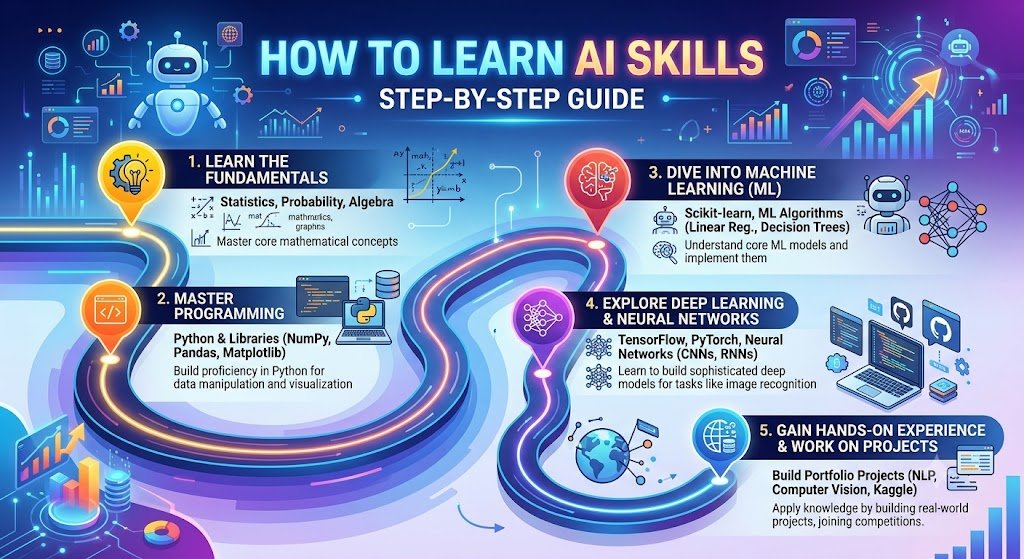
If you are a complete beginner, the easiest approach is to follow a structured learning plan. You do not need to spend money on expensive courses immediately. Start with free resources and practise consistently.
Step 1: Understand the Basics of Artificial Intelligence
Begin by learning what artificial intelligence is and how it differs from machine learning, deep learning, and generative AI.
Understand that AI is a broad field, machine learning is one approach within AI, and generative AI focuses on producing content such as text, images, audio, and code.
You do not need to memorise technical definitions. Focus on understanding the concepts and recognising examples from everyday life.
Step 2: Choose Your Learning Goal
Before selecting tools or courses, decide why you want to learn AI.
You might want to use AI for blogging, improve your digital marketing skills, complete college assignments more efficiently, develop technical skills, or build a freelance service.
Choosing a goal helps you avoid wasting time learning topics that are not immediately relevant to you.
For example, a blogger should initially focus on research, writing assistance, SEO analysis, and image creation. Someone interested in machine learning should eventually study programming, statistics, and model development.
Step 3: Start Practising With Beginner-Friendly Tools
Choose a conversational AI tool and practise everyday tasks. Ask it to explain unfamiliar concepts, suggest ideas, summarise a passage, or help you organise a project.
Then experiment with a writing tool, image generator, or spreadsheet assistant if it supports your goals.
Try the same task using different instructions and compare the results. This will teach you how to give better instructions and evaluate output quality.
Step 4: Follow Free Courses and Tutorials
Use structured courses to learn the concepts you cannot understand through experimentation alone.
Study one topic at a time, take notes, and complete exercises rather than simply watching videos. A short lesson followed by practical work is often more useful than watching several hours of tutorials without applying anything.
Choose beginner courses that match your goals and check whether their content, software requirements, and access conditions are current.
Step 5: Build Small Projects
Apply your knowledge to a real task. You could prepare a blog content calendar, create a frequently asked questions document, analyse a small spreadsheet, or develop a simple chatbot prototype.
Small projects help you understand what AI can do, where it makes mistakes, and how much human review is necessary.
Save your best projects so that you can demonstrate your abilities later.
Step 6: Review Your Progress and Improve
At the end of every week, review what you learned and identify the areas that need improvement.
Ask yourself whether you can complete a task without copying a tutorial, explain the process to another person, and recognise common errors.
Gradually increase the difficulty of your projects. Once you feel confident with the basics, explore specialised areas such as AI marketing, data analytics, Python programming, or automation.
A Simple 30-Day AI Learning Plan
You can use this four-week schedule to organise your learning.
- Week 1 — Learn the basics: Understand AI concepts, explore a chatbot, and practise writing clear prompts.
- Week 2 — Develop practical skills: Experiment with writing, research, image creation, or data tools that support your goal.
- Week 3 — Build a project: Create one useful piece of work, such as a blog article, content calendar, or simple data analysis.
- Week 4 — Improve and showcase: Check your work, correct mistakes, complete a second project, and organise your results into a small portfolio.
Aim for around 30–60 minutes of focused practice per day if your schedule allows. You can adjust the pace depending on your studies, work, and other responsibilities.
The objective is to build a consistent learning habit, not to master every AI technology in 30 days.
Best Free AI Courses and Learning Resources
How to Learn AI Skills
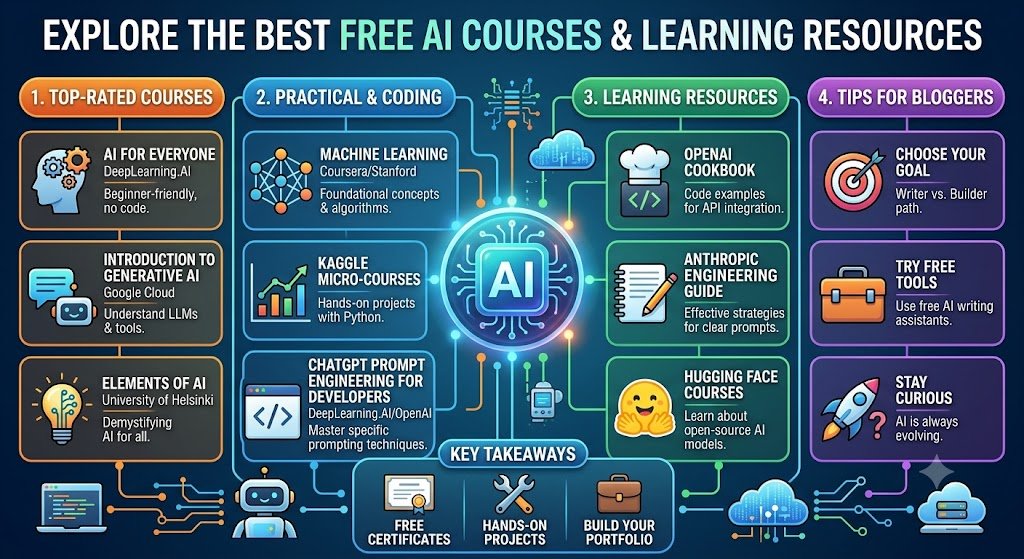
You can begin learning AI without purchasing an expensive programme. Several educational platforms provide introductory materials, tutorials, and courses. Some offer free access to selected lessons, while certificates or advanced features may require payment.
Here are useful places to start.
1. Google AI Learning Resources
Google offers AI learning materials covering topics such as generative AI, responsible AI, and machine learning. These resources can help beginners understand AI concepts and discover practical applications.
Explore the available lessons and select material that matches your current knowledge.
Website: https://ai.google/learn/
2. Microsoft Learn
Microsoft Learn provides educational modules on AI concepts, generative AI, and related technologies. It is useful for learners who prefer structured lessons and guided exercises.
Some learning paths focus on particular Microsoft products, so check the prerequisites before starting.
Website: https://learn.microsoft.com/en-us/training/
3. Elements of AI
Elements of AI is an educational initiative designed to make artificial intelligence more accessible. Its introductory material explains important concepts in a way that does not assume that every learner has a technical background.
It is a useful starting point if you want to understand AI before moving into programming.
Website: https://www.elementsofai.com/
4. IBM SkillsBuild
IBM SkillsBuild provides educational resources related to technology and professional skills, including AI. Depending on the available learning path, you can explore introductory concepts and practical applications.
Check the current course details, eligibility, and certificate conditions before enrolling.
Website: https://skillsbuild.org/
5. Kaggle Learn
Kaggle Learn offers short, practical courses in areas such as Python, data visualisation, and introductory machine learning. It is especially useful when you want to move beyond using AI tools and begin working with data and code.
Some courses are more suitable after you understand basic programming concepts.
Website: https://www.kaggle.com/learn
Beginner tip: Start with one introductory course and complete it before moving to another. Taking notes, practising the exercises, and building a small project will help you apply what you learn.
How to Learn AI Skills
Best AI Tools to Practise Your Skills

How to Learn AI Skills
Learning becomes easier when you practise with tools that match your goals. You can start with a few familiar applications and expand your toolkit as your skills improve.
1. ChatGPT
ChatGPT can help you brainstorm ideas, understand concepts, outline articles, practise prompts, and explore solutions to everyday problems.
For example, you can ask it to explain a difficult topic in simple language or provide feedback on a draft you have written.
Website: https://chatgpt.com/
2. Google Gemini
Google Gemini can assist with tasks such as brainstorming, explaining topics, drafting content, and working with supported information and files.
Try using it to compare explanations of a topic or develop ideas for a personal project.
Website: https://gemini.google.com/
3. Canva
Canva includes design tools and AI-powered features that can help you create social media graphics, presentations, and visual content.
It can be useful for bloggers and digital marketers who want to practise visual communication without starting with advanced graphic design software.
Website: https://www.canva.com/
4. NotebookLM
NotebookLM can help you work with supported source materials, organise information, and explore questions about documents you provide.
It can be useful for studying, preparing research notes, and understanding lengthy material. Always check important conclusions against the original sources.
Website: https://notebooklm.google.com/
5. Google Colab
Google Colab provides a browser-based environment for writing and running Python notebooks. It is useful for beginners who want to experiment with code, data analysis, and machine learning without setting up a complete programming environment on their computer.
Some projects may require additional setup or computing resources.
Website: https://colab.research.google.com/
You do not need to use every tool on this list. Choose two or three that support your immediate goals, practise regularly, and check the current free-plan limits before depending on a feature.
How to Learn AI Skills
How to Build AI Projects Without Experience
How to Learn AI Skills
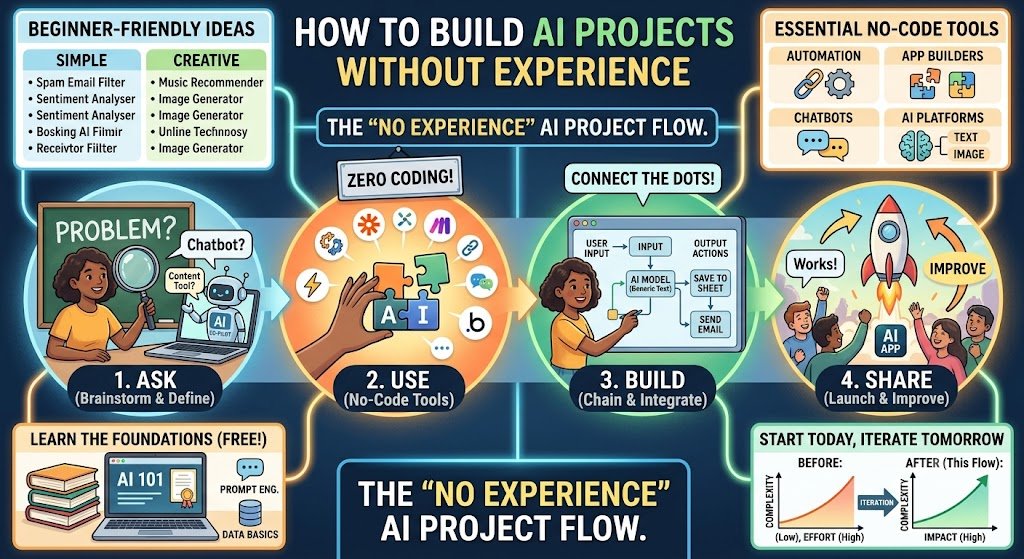
One of the best ways to learn AI skills is to build small projects. A project allows you to apply what you have learned, solve a practical problem, and demonstrate your abilities to potential clients or employers.
You do not need to create a complicated application to get started. Begin with something you can finish and improve.
Project 1: Create an AI-Assisted Blog Article
If you are interested in blogging, choose a topic and use AI to brainstorm ideas, organise headings, and identify questions readers may ask.
Write the article in your own editorial voice, verify facts, check references, and edit the final draft. The finished project can demonstrate research, prompt writing, content planning, and editing skills.
Project 2: Build a Social Media Content Calendar
Prepare a seven-day content calendar for a fictional business or a topic you understand.
Use AI to brainstorm post ideas, draft captions, and suggest formats. Organise the results in a spreadsheet, then review them for accuracy, originality, and relevance to the audience.
This project can help you practise AI-assisted marketing and content organisation. How to Learn AI Skills
Project 3: Analyse a Small Dataset
Find a suitable public dataset or create a small sample spreadsheet containing fictional information.
Use spreadsheet tools or Python to calculate totals, compare categories, and create charts. If you use AI for assistance, verify the calculations yourself.
This project is a useful introduction to data literacy and analytical thinking.
Project 4: Create a Simple AI Chatbot Prototype
If you want to explore technical skills, build a basic question-and-answer prototype using a suitable beginner platform or programming tutorial.
Start with a limited purpose, such as answering frequently asked questions about a fictional website. Test it with different questions and document the answers it handles poorly.
Do not include private or confidential information in an experimental system.
How to Present Your Projects
Keep a record of each project, including the problem you wanted to solve, the tools you used, the steps you followed, and the final result.
Explain which parts were produced with AI and which parts you completed or verified yourself. A small portfolio of well-reviewed projects is more useful than a long list of tools you have tried without producing anything.
How to Learn AI Skills
How to Use AI Skills to Earn Money Online

How to Learn AI Skills
Once you have developed practical skills, you can explore ways to turn them into useful services. However, learning AI does not guarantee an income. Earnings depend on your ability, the quality of your work, market demand, client trust, and consistency.
Here are several paths worth exploring.
1. AI-Assisted Content Writing
Businesses and website owners need articles, product descriptions, newsletters, and other written content.
You can offer writing and editing services supported by AI research and drafting tools. To stand out, focus on clear writing, original insights, accurate information, and content tailored to the client’s audience.
Avoid simply generating unedited AI text and selling it as finished professional work.
2. Social Media Content Creation
Small businesses may need help planning posts, writing captions, preparing content calendars, and creating graphics.
You can combine AI writing tools with design applications to prepare content packages. Learn basic branding, audience research, visual design, and social media strategy alongside AI.
3. Blogging and Affiliate Marketing
If you enjoy writing, you can build a blog around a subject you understand, such as AI tools, technology news, or digital marketing.
AI can assist with brainstorming, outlining, and editing, but your blog should offer useful information, careful fact-checking, and original value.
Possible monetisation methods include advertising, affiliate links, and relevant services. These usually require time to build traffic and trust, and income is not guaranteed.
4. AI-Assisted Research and Data Organisation
Some businesses need help organising information, summarising public documents, cleaning spreadsheets, or preparing basic reports.
You can learn these skills and offer clearly defined services. Protect confidential data, verify your results, and never claim to have completed technical analysis that you cannot explain.
5. AI Automation Services
With additional learning, you can explore workflows that connect forms, spreadsheets, email systems, and other business applications.
Automation can save time on repetitive tasks, but reliable solutions require testing, error handling, and an understanding of the tools being connected. Start with simple projects before offering complex automation to clients.
How Can Beginners Find Their First Client?
Start by creating two or three sample projects that demonstrate the service you want to offer. Prepare a simple portfolio, describe the result you can deliver, and contact relevant potential clients through suitable freelance platforms or professional networks.
Focus on solving one specific problem rather than advertising yourself as an expert in every AI technology.
You can begin learning with free tools, but remember that earning money requires more than knowing how to use AI. Communication, reliability, problem-solving, and delivering quality work are equally important. How to Learn AI Skills
How to Learn AI Skills
Common Mistakes to Avoid When Learning AI
How to Learn AI Skills
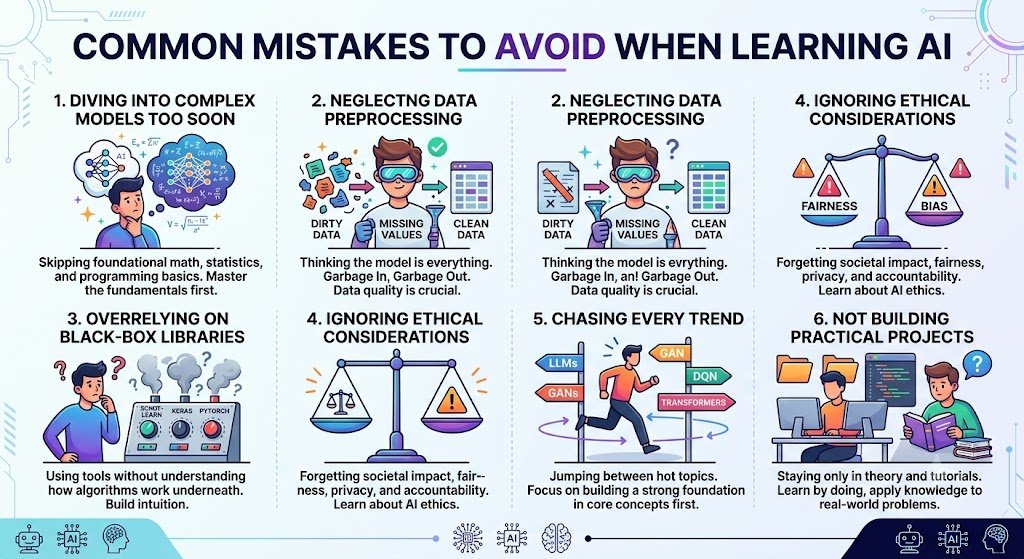
Many beginners become frustrated because they try to learn too many things at once. Avoiding a few common mistakes can make your learning journey more manageable.
1. Trying to Learn Every AI Tool
New AI applications appear regularly, and it is easy to spend all your time exploring them.
Choose tools that support your goal and learn to use them well before adding more. Understanding core concepts is more valuable than constantly switching between applications.
2. Depending Completely on AI
AI can help you work faster, but it can also make errors or misunderstand instructions.
Review its answers, verify important claims, and use your own judgement. Your ability to evaluate AI output is an important skill in its own right.
3. Watching Tutorials Without Practising
Watching educational videos may help you understand a concept, but passive learning does not always prepare you to use it.
After every lesson, complete a small exercise or project. Practical experience helps you discover what you understand and what needs further study.
4. Expecting to Earn Money Immediately
Learning a new skill takes time, and finding paying clients can take even longer.
Avoid promises of guaranteed income or expensive programmes claiming that AI will make you rich overnight. Build useful skills, practise consistently, and treat earning money as a possible outcome rather than an immediate certainty.
5. Ignoring Privacy and Copyright
Do not upload passwords, confidential business documents, personal information, or sensitive client data to AI tools without proper authorisation and suitable safeguards.
Also, check the usage terms and applicable rights for AI-generated images, text, and other materials before publishing or selling them.
6. Giving Up Too Early
Your first prompts may produce weak results, your first project may contain mistakes, and some technical topics may take several attempts to understand.
Treat these difficulties as part of the learning process. Review your errors, adjust your approach, and continue practising. How to Learn AI Skills
How to Learn AI Skills
Frequently Asked Questions About Learning AI Skills

How to Learn AI Skills
1. How can I learn AI skills as a complete beginner?
Start by understanding basic AI concepts, practising with a beginner-friendly chatbot, and learning to write clear prompts. Then follow a free introductory course and complete small projects connected to your interests. You can gradually explore more technical topics as your confidence grows.
2. Can I learn AI skills for free?
Yes. You can start with free educational resources, tutorials, documentation, and tools that offer free access. Some platforms restrict advanced features, usage, or certificates to paid plans, so check their current conditions before enrolling.
3. Do I need coding skills to learn AI?
No. You can learn to use AI tools for writing, research, marketing, design, and productivity without learning to code first. If you want to build AI applications or work in machine learning, learning Python and other technical concepts will be useful.
4. How long does it take to learn AI skills?
The time depends on your goal, previous experience, and the amount of practice you can manage. You may learn basic AI tool usage in a relatively short period, while programming, machine learning, and advanced AI development require more sustained study. Focus on measurable progress rather than a fixed deadline.
5. Which AI skills are best for beginners?
Prompt writing, AI tool usage, fact-checking, data literacy, problem-solving, and communication are useful starting points. You can then specialise in an area such as content creation, digital marketing, automation, data analysis, or machine learning.
6. Can I earn money after learning AI skills?
Yes, AI skills can support services such as content writing, social media management, research, data organisation, and automation. However, income is not guaranteed. You need practical experience, a good portfolio, reliable delivery, and services that clients are willing to pay for.
7. What is the best way to practise AI skills every day?
Choose one small task, such as improving a prompt, researching a topic, creating a visual, or analysing a spreadsheet. Compare your results, check for errors, and record what you learned. Consistent practice helps you build confidence and improve your judgement.
8. Which free AI course should I take first?
If you want a broad introduction, explore Elements of AI or introductory resources from Google AI. If you want to move towards programming and machine learning, consider Kaggle Learn after reviewing its beginner prerequisites. Select one course that matches your goal and complete it before moving to another. How to Learn AI Skills
Conclusion: Start Learning AI Skills Today
Learning AI does not have to be complicated or expensive. You can begin with the basics, practise with accessible tools, explore free courses, and gradually build projects that demonstrate what you know.
The most effective way to learn AI skills is to combine curiosity with consistent practice. Do not focus only on collecting certificates or trying every new application. Instead, learn how to solve problems, verify information, communicate clearly, and use AI responsibly.
Start with one skill, set a realistic learning goal, and practise for a little time each day. As your experience grows, you can explore specialised career paths, develop a portfolio, and investigate opportunities to offer useful services online.